By Gene Shenker, DPT, Founder & CEO, RehabStride™ AFO
Foot drop can be frustrating in any situation, but when it happens together with hereditary spastic paraplegia, also known as HSP or spastic paraparesis, the walking problem is usually more complex than simply “the foot does not lift.” Many people with HSP are not only dealing with weak dorsiflexion. They may also experience stiffness, spasticity, clonus, reduced balance, hip weakness, fatigue, difficulty advancing the legs, and the need for canes, walkers, AFO braces, or functional electrical stimulation.
That is why the question, “Will an AFO brace work for HSP?” deserves a careful answer.
For some people, an ankle-foot orthosis may help improve foot clearance, ankle positioning, heel strike, and walking confidence. For others, especially when spasticity or clonus is strong, the wrong brace may feel restrictive, uncomfortable, or may not address the main reason walking is difficult. The most honest answer is this: an AFO brace can be part of the solution for some individuals with HSP-related foot drop, but it should be selected carefully, ideally with input from a physical therapist, orthotist, neurologist, or rehabilitation specialist who understands neurological gait disorders.
This article explains what makes HSP-related foot drop different, how AFO braces may help, when dynamic support may be worth considering, and when extra caution is needed.
Understanding Foot Drop in Hereditary Spastic Paraplegia
Hereditary spastic paraplegia (HSP) is a group of genetic neurological disorders that primarily affect the long nerve pathways controlling the legs. Many people with HSP experience progressive difficulty walking due to lower-limb spasticity and weakness. Depending on the type of HSP and the severity of symptoms, walking problems may develop slowly over years and can vary greatly from person to person.
Foot drop in HSP may look similar to foot drop from a peroneal nerve injury, stroke, multiple sclerosis, or neuropathy, but the underlying walking pattern can be different. In a simple foot drop case, the main problem may be weakness of the muscles that lift the front of the foot. In HSP, the person may also have increased muscle tone, overactive reflexes, stiffness in the legs, poor selective motor control, scissoring, circumduction, or clonus at the ankle.
This matters because a brace that works well for one type of foot drop may not automatically work well for another.
A person with HSP may describe problems such as:
- The toes catching during swing phase
- Difficulty clearing the foot while walking
- Stiffness in the calves, hamstrings, or hip muscles
- Weak hip flexors that make it hard to advance the leg
- Clonus or shaking at the ankle, especially with quick stretch
- Trouble walking downhill, on stairs, or over uneven ground
- Needing two canes, walking sticks, or a walker
- Fatigue from compensating with the hips, knees, or trunk
- Difficulty using standard AFO braces comfortably
- Mixed results with functional electrical stimulation
These real-world details are important. A brace decision should not be based only on the diagnosis code. It should be based on how the person actually walks, what triggers spasticity, what improves safety, and what level of assistance is needed.
Why HSP Walking Problems Are More Complex Than Standard Foot Drop
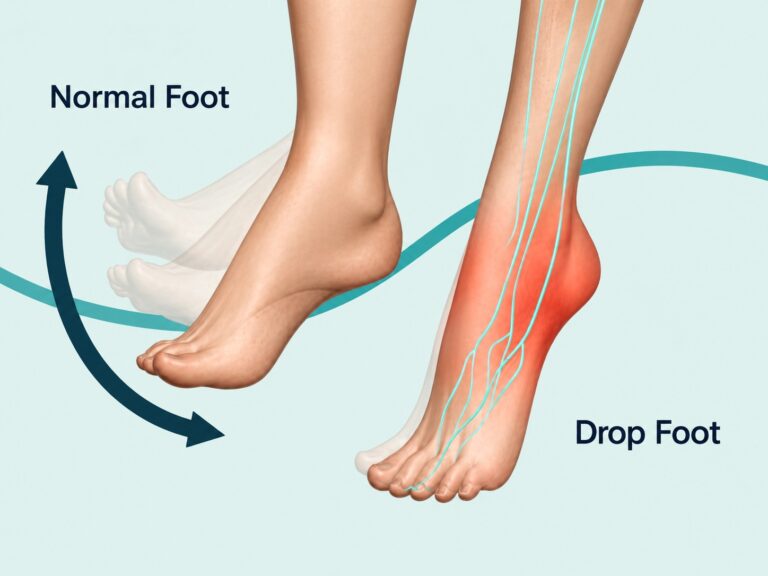
Foot drop is often explained as the inability to lift the front of the foot during walking. That explanation is useful, but it is incomplete for HSP.
In HSP, the foot may drop because the dorsiflexor muscles are weak. But the foot may also fail to clear the ground because the leg is stiff, the knee does not bend enough, the hip flexors are weak, the ankle is pulled into plantarflexion by tone, or the timing of muscle activation is abnormal. In some cases, clonus can cause repeated involuntary contractions at the ankle, making the foot feel unstable or difficult to control.
This is why the same person may say, “I have foot drop,” but also describe spasticity, weak hip flexors, bilateral AFOs, FES, and two canes. That is not a basic brace question. That is a neurological gait question.
AFO braces are most helpful when they address a specific mechanical problem. For example, if the toes drag because the ankle does not lift during swing phase, an AFO may help improve foot clearance. If the foot slaps down after heel strike, an AFO may help with controlled positioning. If the ankle rolls, certain AFO designs may help with alignment.
However, if the main walking limitation comes from severe hip flexor weakness, uncontrolled spasticity, strong clonus, knee buckling, or poor balance, the AFO may only solve part of the problem. It may still be useful, but expectations must be realistic.
How AFO Braces May Help with HSP-Related Foot Drop
An ankle-foot orthosis, or AFO, is designed to support the ankle and foot during standing and walking. In foot drop, AFO braces are often used to reduce toe drag and improve safety during swing phase. The right brace may help the foot clear the ground, improve initial contact, support ankle alignment, and reduce the need for compensations such as excessive hip hiking or high-steppage gait.
For people with HSP, potential AFO benefits may include:
Improved toe clearance
If the front of the foot drops during swing phase, the toes may catch the floor. AFO support may help position the foot so the person can step forward with less dragging.
More consistent heel strike
Many people with foot drop land with a flat foot, forefoot, or unstable contact pattern. AFO support may help improve the position of the foot at initial contact.
Better walking stability
When the foot is better positioned, some users feel more stable. This can be especially meaningful for people who already use canes or walkers.
Reduced compensation
When the foot clears more reliably, the person may not need to lift the hip or knee as much to avoid tripping. This may reduce fatigue for some users.
Improved confidence
Fear of falling can be just as limiting as weakness. If a brace helps the person feel more predictable and secure during walking, confidence may improve.
Still, these benefits depend on the person’s specific gait pattern. HSP can vary widely, and not every person with HSP will respond the same way to the same AFO.
The Challenge of Spasticity and Clonus
Spasticity is not the same as weakness. Weakness means the muscle has difficulty producing force. Spasticity involves increased muscle tone and exaggerated reflex activity. Clonus is a rhythmic, involuntary contraction that can occur when a muscle is stretched, often seen at the ankle.
These symptoms can complicate AFO use.
For example, a brace that moves the ankle into dorsiflexion may help with foot clearance, but if that motion triggers clonus, the person may feel shaking, instability, or discomfort. A brace that is too stiff may reduce unwanted motion, but it may also make walking feel more mechanical or may interfere with stairs, ramps, or uneven surfaces. A brace that is too flexible may feel comfortable but may not provide enough control when tone increases.
This is why people with HSP often need a more detailed evaluation than someone with mild isolated foot drop. Clinicians may need to look at:
- How much passive ankle range is available
- Whether the ankle can tolerate dorsiflexion without triggering clonus
- Whether the foot pulls into inversion or plantarflexion
- Whether the knee hyperextends or buckles
- Whether hip flexion weakness is limiting limb advancement
- Whether spasticity changes with speed, fatigue, or terrain
- Whether the person uses canes, walker, or wheelchair for safety
- Whether the current AFO or FES setup is helping or creating new problems
AFO bracing for HSP is not just about lifting the foot. It is about matching the brace to tone, strength, balance, endurance, safety, and functional goals.
AFO vs. FES for Neurological Foot Drop
Some people with HSP use functional electrical stimulation, also known as FES. FES devices stimulate specific nerves or muscles during walking to help lift the foot at the right time. For certain neurological foot drop cases, FES can be helpful because it provides active stimulation rather than purely mechanical support.
However, FES is not ideal for every person. It may depend on nerve integrity, skin tolerance, stimulation comfort, timing accuracy, muscle fatigue, spasticity response, and the person’s ability to set up and use the device consistently. Some people do very well with FES. Others find it inconsistent, uncomfortable, difficult to manage, or less effective when fatigue increases.
AFO braces and FES are not always competitors. They are different tools. Some people use an AFO for longer distances or outdoor walking and FES for specific settings. Others use FES when they want stimulation and an AFO when they need more predictable mechanical support. Some may need a more stable brace because FES does not provide enough control.
For someone with HSP who already uses bilateral AFOs or FES and two canes, the key question is not, “Which device is best?” The better question is:
Which option provides the safest, most functional walking pattern with the least restriction and the best real-world usability?
Why Bilateral Foot Drop Changes the Brace Conversation
Bilateral involvement makes everything more demanding.
When only one foot drops, the other side may compensate. When both sides are affected, the person has less room for error. Balance can become more difficult, fatigue can build faster, and even small brace issues can have a larger effect on walking.
For people with bilateral foot drop from HSP, important brace considerations include:
- Brace weight
- Ease of putting the brace on and taking it off
- Shoe compatibility
- Skin tolerance
- Stability on both sides
- Whether the brace affects stair negotiation
- Whether the brace allows enough motion for functional walking
- Whether it works with canes, walker, or other assistive devices
- Whether it increases or decreases energy cost
- Whether one side needs different support than the other
It is common for one side to be more involved than the other. For example, someone may have more clonus in the left foot and more weakness or fatigue on the right. In that situation, each side may need a different tension level, brace setup, or clinical strategy.
Where RehabStride™ AFO May Fit
RehabStride™ AFO is designed as a dynamic AFO brace for foot drop. Unlike many rigid braces that hold the ankle in a fixed position, RehabStride™ uses a tension-adjustable cable system to assist dorsiflexion while allowing more natural ankle motion. It is also designed to fit most shoes, provide adjustable lift, support smoother foot clearance, and allow quick release for easier removal or rest.
For some people with neurological foot drop, this type of dynamic support may be worth discussing with a clinician because it may offer a different experience than traditional rigid AFOs. The goal is not simply to hold the foot up. The goal is to assist the foot during walking while still allowing controlled movement.
RehabStride™ AFO may be worth considering or discussing when a person has:
- Foot drop or poor toe clearance during walking
- Difficulty with rigid AFO comfort or mobility
- A desire for adjustable dorsiflexion assistance
- Some ability to tolerate controlled ankle motion
- Need for a low-profile brace that works with everyday shoes
- Frustration with fixed-position bracing
- A rehabilitation goal that includes active movement, when appropriate
For a person with HSP, this does not mean RehabStride™ is automatically the right brace. It means it may be a possible option to evaluate carefully, especially if the person is looking for adjustable mechanical dorsiflexion assistance and wants to avoid feeling completely locked into a rigid brace.
When RehabStride™ or Any Dynamic AFO Requires Extra Caution
This is the most important part of the conversation.
A dynamic AFO may not be the right first option for every person with HSP. Some individuals need more rigid control for safety. Others may have spasticity patterns that require custom orthotic management. In some cases, ankle motion may trigger clonus or increase instability. In other cases, the main limitation may be at the hip, knee, or trunk rather than the ankle.
Extra caution is needed when a person has:
- Severe uncontrolled spasticity
- Strong clonus triggered by ankle movement
- Significant ankle inversion tone
- Severe knee hyperextension or knee buckling
- Very weak hip flexors
- Poor standing balance
- Frequent falls
- Skin breakdown or poor sensation
- Severe contracture or limited ankle range
- Bilateral involvement requiring two canes, walker, or close supervision
- Rapidly changing neurological symptoms
In these situations, the safest recommendation is clinical evaluation before changing brace type. A physical therapist or orthotist can assess whether a dynamic AFO provides enough control, whether the ankle can tolerate the motion, and whether the brace improves or worsens the person’s overall gait pattern.
Questions to Ask Before Trying a New AFO for HSP
If you have HSP and are considering a new AFO brace, it may help to ask the following questions:
- Is my main issue foot drop, spasticity, hip weakness, balance, or a combination?
- Does ankle dorsiflexion trigger clonus?
- Do I need rigid ankle control, dynamic assistance, or a hybrid approach?
- Does my current AFO improve walking, or does it feel too restrictive?
- Does FES work consistently for me, or does fatigue reduce its benefit?
- Do I need different support on the left and right sides?
- Can I safely test a new brace with my canes, walker, or usual assistive device?
- Does the brace improve toe clearance without increasing knee or hip problems?
- Can I use the brace safely on stairs, ramps, and uneven ground?
- Who will help me adjust the brace and monitor my response?
These questions show why a careful fitting process matters. AFO selection is not just about the product. It is about matching the device to the person.
A Clinically Honest Answer for Someone with HSP, Spasticity, Clonus, Weak Hip Flexors, and Two Canes
For someone who says, “I have spastic paraparesis or HSP. I use AFOs or FES bilaterally with two canes. I have a lot of spasticity, weak hip flexors, and clonus that is more prominent in the left foot,” the answer should be thoughtful and cautious.
A possible response would be:
RehabStride™ AFO may potentially help with the foot drop component, especially if the main goal is improved toe clearance and adjustable dorsiflexion assistance. However, HSP-related walking difficulty is often more complex than isolated foot drop. Spasticity, clonus, bilateral involvement, weak hip flexors, and cane use all affect whether a dynamic AFO is appropriate. Before making a recommendation, it would be important to understand your ankle range of motion, how easily clonus is triggered, your current AFO/FES experience, your fall history, and whether your main limitation is foot clearance or leg advancement. A brief video of your walking pattern, or a consultation with a clinician familiar with neurological gait, would be the safest next step.
That kind of response is honest, clinically responsible, and respectful of the patient’s real concerns.
Final Thoughts: Support, Safety, and Realistic Expectations
An AFO brace can be helpful for foot drop related to hereditary spastic paraplegia, but HSP is rarely a simple foot drop problem. Spasticity, clonus, weakness, balance, endurance, and bilateral involvement all matter.
For some people, a dynamic AFO like RehabStride™ may offer a more natural-feeling alternative to rigid bracing by providing adjustable dorsiflexion assistance while allowing controlled ankle movement. For others, especially those with severe clonus, strong spasticity, or significant instability, a more controlled or custom orthotic approach may be safer.
The best brace is not always the stiffest brace or the most flexible brace. The best brace is the one that helps the person walk more safely, more efficiently, and with the right amount of support for their body.
If you have HSP, spastic paraparesis, bilateral foot drop, or complex neurological walking challenges, it is important to work with a qualified healthcare professional before changing your bracing strategy. AFOs, FES, physical therapy, spasticity management, strengthening, balance training, and assistive devices may all play a role.
RehabStride™ was created to rethink foot drop support around movement, adjustability, and real-world walking function. For the right user, that may make a meaningful difference. But in complex neurological conditions like HSP, safety and proper clinical screening must always come first.
Sources
- NCBI Bookshelf / GeneReviews – Uncomplicated Hereditary Spastic Paraplegia Overview
https://www.ncbi.nlm.nih.gov/books/NBK1509/ - NCBI Bookshelf / GeneReviews – Spastic Paraplegia 3A
https://www.ncbi.nlm.nih.gov/books/NBK45978/ - NCBI Bookshelf / GeneReviews – Spastic Paraplegia 8
https://www.ncbi.nlm.nih.gov/books/NBK1827/ - Management of Hereditary Spastic Paraplegia – PMC
https://pmc.ncbi.nlm.nih.gov/articles/PMC6349696/ - Hereditary Spastic Paraplegia: Clinical Features and Pathology – PMC
https://pmc.ncbi.nlm.nih.gov/articles/PMC4045499/ - The Impact of Ankle-Foot Orthoses on Toe Clearance Strategy in Hemiparesis – PMC
https://pmc.ncbi.nlm.nih.gov/articles/PMC5966858/ - Ankle-Foot Orthosis Effects on Walking in Stroke Survivors – PubMed
https://pubmed.ncbi.nlm.nih.gov/23798747/ - Functional Electrical Stimulation Versus Ankle-Foot Orthoses for Foot Drop – PubMed
https://pubmed.ncbi.nlm.nih.gov/27563700/
Frequently Asked Questions
Can an AFO brace help with walking problems caused by hereditary spastic paraplegia?
An AFO brace may help some people with hereditary spastic paraplegia when foot drop, poor toe clearance, or unstable foot positioning is part of the walking problem. However, HSP often involves more than simple dorsiflexion weakness. Spasticity, clonus, hip weakness, balance limitations, and bilateral leg involvement can all affect whether a brace is appropriate. A clinical evaluation is recommended before changing bracing strategy.
Is RehabStride™ AFO appropriate for people with spasticity or clonus?
RehabStride™ AFO may be worth discussing when a person needs adjustable dorsiflexion assistance and can tolerate controlled ankle motion. However, strong spasticity or clonus may require extra caution because ankle movement can sometimes trigger shaking, tone, or instability. People with significant clonus, severe spasticity, frequent falls, or major balance concerns should be evaluated by a qualified clinician before trying a dynamic AFO.
How is HSP-related foot drop different from regular foot drop?
Regular foot drop is often caused by weakness of the muscles that lift the front of the foot. In hereditary spastic paraplegia, foot clearance problems may also come from stiffness, overactive reflexes, weak hip flexors, poor knee control, clonus, or difficulty advancing the leg. Because several systems may be involved at once, the best AFO choice depends on the full walking pattern, not only the diagnosis.
What should someone with HSP ask before trying a new AFO brace?
Before trying a new AFO brace, a person with HSP should ask whether their main limitation is foot drop, spasticity, hip weakness, balance, or a combination of these issues. They should also consider whether ankle motion triggers clonus, whether both legs need different support levels, whether the brace works safely with canes or a walker, and whether a clinician can help monitor gait and safety during the trial.
Related posts:
- Breaking Myths About AFO Braces: What You Need to Know
- Telehealth for Mobility: How RehabStride™ Revolutionizes Recovery with Virtual Support
- Active vs. Passive Support: Why Most AFO Braces Fall Short for Foot Drop
- RehabStride AFO Brace vs. Traditional Orthotics: Which One is Right for You?
- Real Movement Returns: How Dynamic Assistance Transforms Foot Drop Mobility