Before You Begin: Setting Up Your RehabStride™ AFO
Before starting this program, ensure your RehabStride™ brace is properly fitted:
- Secure the ankle cuff snugly – not too tight, not too loose
- Attach the cable toe clip to your regular sneaker
- Set cable tension to light resistance to start
- Consult your physical therapist before beginning any new exercise program
 Always listen to your body. If you experience pain (not mild fatigue), stop immediately and consult your clinician.
The Step-by-Step Home Exercise Program
Exercise 1:
Seated Dorsiflexion Lifts
(Weeks 1–2)
Goal: Reactivate the tibialis anterior muscle responsible for lifting the foot.
- Sit upright in a sturdy chair, feet flat on the floor
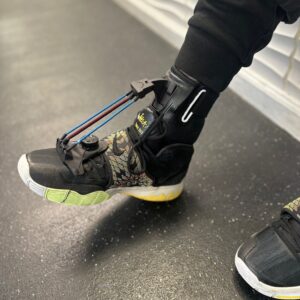
- Wearing your RehabStride™ brace at minimal tension, slowly lift the front of your foot upward
- Hold for 3 seconds, lower slowly
- Repeat 10–15 times, 3 sets
Why it works with RehabStride™: The cable tension provides just enough assistance to initiate movement without eliminating muscle effort – the key to building real strength.
Exercise 2:
Standing Heel-to-Toe Rocks
(Weeks 1–3)
Goal: Improve weight transfer and maintain plantar-flexion (calf) strength.
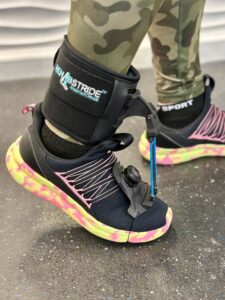
- Stand behind a sturdy chair, holding lightly for balance
- Slowly rock back onto your heels (dorsiflexion), hold 2 seconds
- Roll forward onto your toes (plantar-flexion), hold 2 seconds
- Repeat 10 times, 2–3 sets
Why it works with RehabStride™: Unlike rigid AFOs that block plantar-flexion, RehabStride™’s dynamic design allows full push-off – so your calf doesn’t weaken during rehab.
Exercise 3:
Controlled Gait Training Walks
(Weeks 2–4)
Goal: Restore natural heel-strike-to-toe-off walking pattern.
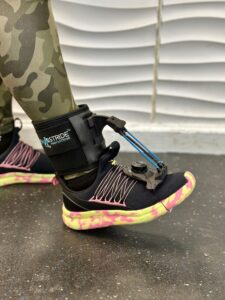
- Put on your RehabStride™ brace with moderate cable tension
- Walk slowly, focusing on initiating each step with a heel strike
- Allow your foot to roll forward naturally to toe-off
- Start with 5–10 minutes, increase by 5 minutes each week
Why it works with RehabStride™: The cable system guides the foot to a precise heel-strike angle, reinforcing correct gait mechanics with every repetition – turning every walk into a therapy session.
Exercise 4:
Single-Leg Balance Training
(Weeks 3–4)
Goal: Rebuild proprioception and ankle stability to reduce fall risk.
- Stand near a wall or chair for safety
- Shift weight onto your affected leg
- Lift your unaffected foot slightly off the ground
- Hold 10–30 seconds, repeat 3–5 times each side
Exercise 5:
Stair Step-Ups
(Weeks 4+)
Goal: Build functional strength for real-world challenges like stairs and inclines.
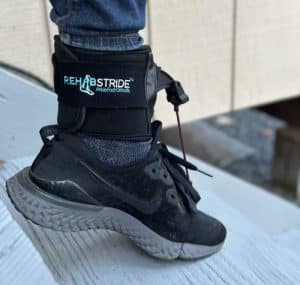
- Stand at the bottom of one step, holding a railing
- Step up with your affected leg first, focusing on controlled dorsiflexion
- Step down slowly and with control
- Repeat 8–12 times, 2–3 sets
Tracking Your Progress: The RehabStride™ Advantage
One of the most powerful features of the RehabStride™ AFO is its adjustable cable tension. As your dorsiflexor strength improves, your physical therapist can gradually reduce the cable tension – meaning the brace does less and your muscles do more.
This progressive approach transforms the brace from a compensation tool into a rehabilitation partner. The ultimate goal is always to rely on the device less, not more.
Tips for Getting the Most From Your Home Program
- Consistency over intensity: 20 minutes daily beats 2 hours once a week
- Wear your own footwear: RehabStride™ fits most regular sneakers – exercise in shoes you’ll actually wear daily for maximum real-world carry-over
- Log your progress: Track walk duration, cable tension setting, and how your foot feels each session
- Coordinate with your PT: This home program is designed to complement – not replace – professional physical therapy
Start Your Recovery Today
Foot drop doesn’t have to define how you move. With a structured exercise program and the right rehabilitation tool, meaningful recovery is achievable – at home, in your own shoes, at your own pace.
The RehabStride™ AFO Brace was built for exactly this: turning every step into progress. Developed by physical therapists, backed by clinical trials at Gramercy Physical Therapy in New York City, and trusted by patients recovering from stroke, MS, and nerve injury – it’s the smarter way to treat foot drop.
Ready to take the first step? Contact us or call 212-598-5913 to learn more or place your order.