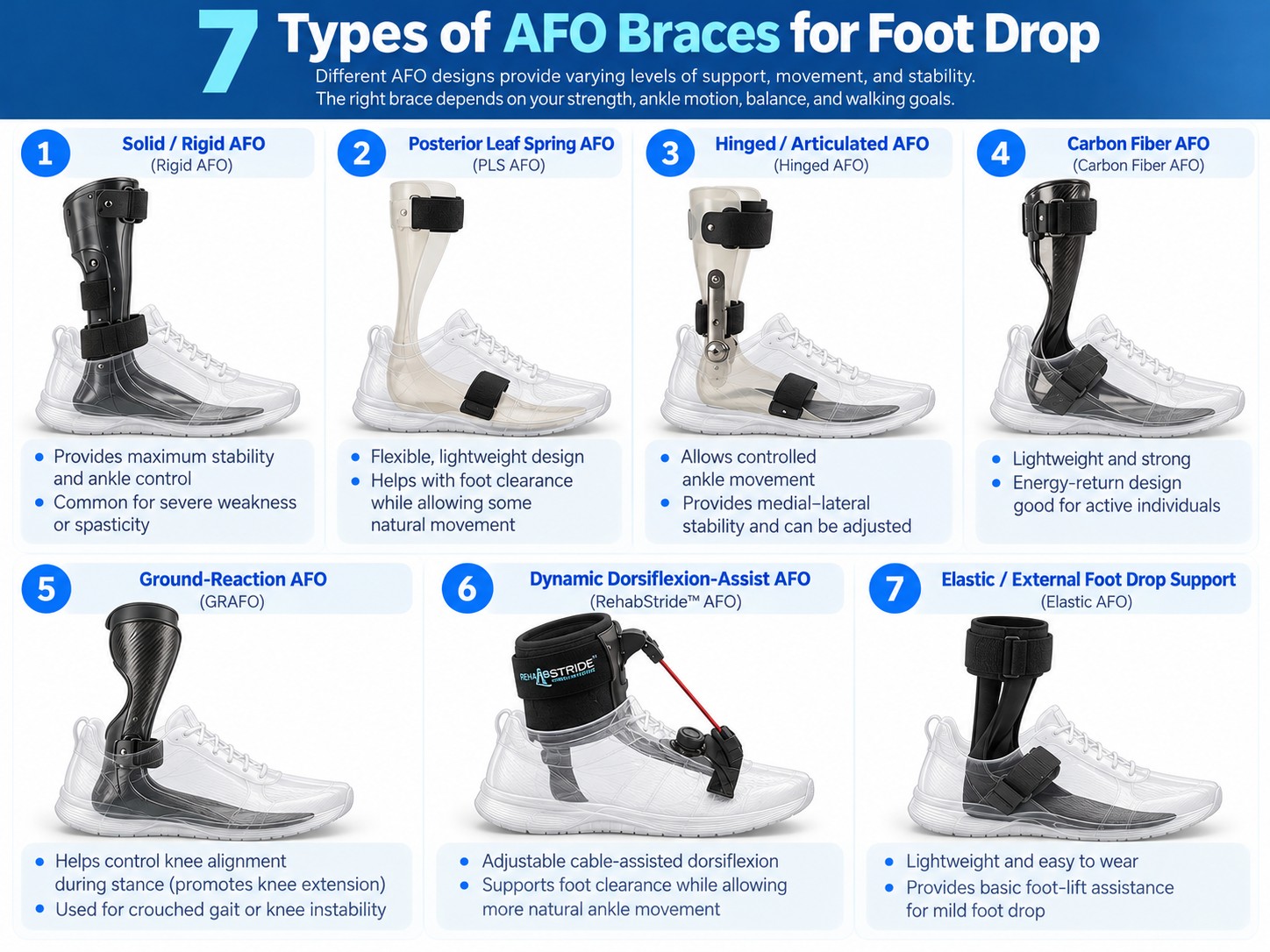
7 Types of AFO Braces for Foot Drop: Which Is Right for You?

By Gene Shenker, DPT, Founder & CEO, RehabStride™ AFO

Choosing the right ankle-foot orthosis (AFO) can make an important difference in walking safety, comfort, and mobility. However, not all AFO braces work the same way. Some restrict ankle movement to provide stability, while others use flexible materials, hinges, springs, or adjustable tension systems to assist walking.

For people living with foot drop, understanding these differences is essential. The right brace should address the specific movement problem – not simply hold the foot in one position.

Innovations such as the RehabStride™ AFO brace have expanded the available options through adjustable dorsiflexion assistance and movement-focused design. However, the most appropriate brace depends on individual strength, ankle range of motion, balance, muscle tone, and walking goals.

This guide explains seven major AFO designs, their advantages and limitations, and the clinical considerations that help determine which type may be suitable.

What Is an AFO Brace, and How Does It Help Foot Drop?

7 Types of AFO Braces for Foot Drop

An ankle-foot orthosis (AFO) is an external supportive device designed to influence the position or movement of the ankle and foot. AFO braces are commonly prescribed for neurological and musculoskeletal conditions affecting walking.

Foot drop occurs when a person has difficulty lifting the front of the foot, a movement called ankle dorsiflexion. This can cause the toes to drag during walking, increasing the risk of stumbling.

Common causes include stroke, peroneal nerve injury, multiple sclerosis (MS), peripheral neuropathy, spinal cord disorders, and other conditions affecting muscle strength or neurological control.

How an AFO Changes the Walking Pattern

Normal walking requires coordinated ankle movement during several phases:

  • Initial contact: The foot meets the ground, often heel-first.

  • Loading response: The ankle controls the foot as body weight transfers forward.

  • Stance and push-off: The body advances over the supporting foot before the ankle contributes to propulsion.

  • Swing phase: The foot lifts from the ground and moves forward for the next step.

An AFO may assist one or more of these functions by improving foot clearance, controlling unwanted ankle movement, supporting alignment, or influencing knee mechanics.

The amount of movement permitted varies considerably between designs.

The 7 Main Types of AFO Braces for Foot Drop

AFOs can be classified by their structure, material, stiffness, and mechanical function. The following seven categories represent commonly used designs and practical options for foot drop management.

These categories sometimes overlap. For example, a carbon fiber AFO may also provide dynamic dorsiflexion assistance, while a hinged brace may incorporate springs or adjustable resistance.

1. Solid or Rigid AFO

A solid ankle-foot orthosis is designed to substantially restrict ankle movement and maintain the foot and ankle within a controlled alignment.

Typically manufactured from molded thermoplastic or composite materials, rigid AFOs provide support for individuals who need significant ankle control.

Potential advantages:

  • Strong control of ankle positioning

  • Support for substantial dorsiflexor weakness

  • Assistance with certain ankle alignment problems

  • Potential influence on knee stability during standing and walking

Limitations:

Because the ankle is substantially restricted, a solid AFO may reduce normal ankle motion during walking, stair negotiation, and push-off. Comfort and functional performance depend on its alignment, stiffness, footwear, and individual gait mechanics.

Clinical consideration: Solid AFOs may be appropriate when stability and control are more important than preserving ankle mobility.


2. Posterior Leaf Spring AFO

A posterior leaf spring (PLS) AFO is a flexible orthosis that typically includes a narrow posterior section designed to bend slightly during walking.

This flexibility allows the brace to provide some resistance to plantarflexion while permitting limited movement.

Potential advantages:

  • Generally lighter and less restrictive than a solid AFO

  • Provides assistance with swing-phase foot clearance

  • May accommodate some ankle movement during walking

  • Often suitable for selected cases of relatively uncomplicated foot drop

Limitations:

A posterior leaf spring AFO generally provides less control of side-to-side ankle instability than more substantial orthotic designs.

It may also be insufficient when significant spasticity, deformity, or knee instability is present.

Clinical consideration: PLS braces may be considered when dorsiflexion weakness is the primary problem and extensive multiplanar stability is not required.


3. Hinged or Articulated AFO

A hinged AFO incorporates an ankle joint mechanism that permits selected movement between the foot section and lower-leg component.

Depending on the design, the hinge may allow dorsiflexion, restrict plantarflexion, or incorporate mechanical stops and spring assistance.

Potential advantages:

  • Permits controlled ankle movement

  • Can support functional movement during walking

  • May accommodate certain gait patterns better than fixed-position braces

  • Adjustable joint configurations are available in some models

Limitations:

Hinged braces can require more careful fitting and alignment. They may be unsuitable when substantial ankle instability, severe contracture, or inadequate joint control is present.

The presence of a hinge does not automatically make an AFO appropriate for every person with foot drop.

Clinical consideration: Articulated AFOs may be useful when controlled ankle mobility is desirable and the person has sufficient stability to use the joint mechanism safely.


4. Carbon Fiber AFO

Carbon fiber AFOs use lightweight composite materials to provide structural support and, in certain designs, elastic energy storage and return.

Some carbon fiber braces have flexible struts that deform under load and return toward their original shape during walking.

Potential advantages:

  • Lightweight construction

  • High strength relative to weight

  • Energy-return properties in selected designs

  • Potential improvements in walking efficiency and comfort

  • Low-profile options available

Limitations:

Carbon fiber AFOs vary substantially in stiffness and design. Some provide significant resistance to ankle movement, while others are more flexible.

Many models have fixed mechanical characteristics that cannot be easily changed by the user. They may also require specific footwear adjustments.

Clinical consideration: Carbon fiber describes the material, not one standardized level of ankle support. The specific design and its mechanical properties should guide selection.


5. Ground-Reaction AFO (GRAFO)

A ground-reaction AFO, sometimes called a floor-reaction AFO, is designed to influence both ankle and knee mechanics during standing and walking.

These braces commonly use an anterior tibial shell and a structural configuration intended to help manage excessive knee flexion during stance.

Potential advantages:

  • Can support knee extension during weight-bearing

  • Provides substantial ankle-foot control

  • May assist selected patients with crouched walking patterns

  • Can improve alignment when appropriately prescribed

Limitations:

Ground-reaction AFOs can restrict ankle movement and are not suitable for every knee alignment or walking pattern.

They are generally more specialized than simple foot drop braces.

Clinical consideration: A ground-reaction AFO may be considered when knee control during stance is a significant concern, rather than isolated weakness of the ankle dorsiflexors.


6. Dynamic Dorsiflexion-Assist AFO

Dynamic dorsiflexion-assist AFOs are designed to help lift the foot during walking while permitting a degree of ankle movement.

Depending on the device, assistance may come from springs, flexible components, elastic elements, or cable-based mechanisms.

Unlike a solid AFO, the goal is not necessarily to immobilize the ankle. Instead, the brace provides mechanical assistance during the portions of gait when it is needed.

Potential advantages:

  • Assists foot clearance during swing phase

  • May allow greater ankle mobility than rigid designs

  • Can support more adaptable walking mechanics

  • Some models offer adjustable assistance

  • May provide a lower-profile alternative to traditional braces

Limitations:

Dynamic designs may not provide adequate control for severe instability, strong spasticity, significant deformity, or complex knee problems.

It is also important to distinguish mechanical assistance from powered technology. A spring- or cable-assisted AFO can provide dynamic movement support without using a motor or electrical stimulation.

Clinical consideration: Dynamic AFOs may be appropriate when dorsiflexion assistance is needed but preserving controlled ankle motion is also an important goal.


7. Elastic and External Foot Drop Braces

Elastic foot drop supports frequently use straps, tension bands, or shoe-mounted attachments to help position the front of the foot during walking.

These devices are generally simpler than conventional molded AFOs.

Potential advantages:

  • Lightweight construction

  • Often relatively easy to apply

  • Some designs accommodate regular footwear

  • May provide sufficient assistance for selected mild foot drop presentations

Limitations:

Simple elastic systems often offer limited control of ankle inversion, eversion, and knee mechanics.

Their effectiveness depends on attachment position, tension, footwear, and the user’s strength and stability.

Clinical consideration: Elastic supports may help selected individuals with relatively straightforward dorsiflexion weakness, but they should not be assumed equivalent to a custom or more structurally supportive AFO.

AFO Brace Comparison Chart

The following table summarizes the main functional characteristics of each AFO design.

AFO TypeAnkle MovementPrimary FunctionCommon Limitation
Solid / Rigid AFOHighly restrictedStability and ankle controlReduced ankle mobility
Posterior Leaf SpringLimited flexibilityFoot clearanceLimited side-to-side support
Hinged AFOControlled joint movementMotion and alignment controlRequires appropriate stability
Carbon Fiber AFOVaries by designLightweight support and possible energy returnStiffness often fixed
Ground-Reaction AFOUsually restrictedAnkle and knee controlSpecialized fitting requirements
Dynamic Assist AFO RehabStride™ AFO Controlled movementAssisted dorsiflexion May provide insufficient stability for complex cases
Elastic Foot Drop SupportGenerally flexibleBasic foot-lift assistanceLimited ankle and knee control

Important: These are general characteristics, not performance guarantees. Actual function depends on each device's design, stiffness, alignment, fitting, and the individual's gait pattern.

Which Type of AFO Is Best for Different Foot Drop Conditions?

One of the most common mistakes in choosing an AFO is selecting a brace based only on the medical diagnosis.

Two people with the same diagnosis may require very different support.

Foot Drop After Stroke

Stroke-related foot drop may involve dorsiflexion weakness, altered muscle tone, poor selective motor control, balance deficits, or knee instability.

Some individuals benefit from rigid or articulated AFOs, while others may be candidates for dynamic dorsiflexion assistance or functional electrical stimulation (FES).

Clinical practice guidelines support the use of AFOs and FES to improve several walking outcomes after stroke, but they do not establish one AFO design as universally superior.


Peroneal Nerve Injury

Peroneal nerve injury may produce weakness in the muscles responsible for lifting the foot and controlling certain ankle movements.

When the primary limitation is poor toe clearance, lighter or dynamically assisted AFO designs may be considered.

However, significant inversion instability, sensory impairment, or other deficits may require additional support.


Multiple Sclerosis and Peripheral Neuropathy

People with MS or neuropathy may experience varying combinations of weakness, fatigue, sensory changes, and balance limitations.

Brace weight, comfort, stability, and adjustability may be particularly important when symptoms fluctuate or both legs are affected.

The appropriate orthosis depends on the severity of impairment rather than the diagnosis alone.


Hereditary Spastic Paraplegia and Spastic Foot Drop

Individuals with hereditary spastic paraplegia (HSP) may experience foot drop alongside spasticity, clonus, weak hip flexors, and bilateral walking difficulties.

These factors can substantially influence brace selection.

A dynamic AFO may be worth evaluating in selected cases, but strong clonus, significant spasticity, or poor knee stability may require a different orthotic strategy.

Read our clinical guide: Can an AFO Brace Help with HSP-Related Foot Drop?


Where Does RehabStride™ Fit Among AFO Designs?

RehabStride™ belongs within the broader category of dynamic dorsiflexion-assist ankle-foot orthoses.

Developed by Gene Shenker, DPT, RehabStride™ uses a patented tension-adjustable cable mechanism designed to assist lifting the foot during walking without relying on a rigid ankle-locking shell.

RehabStride AFO brace for foot droop


Adjustable Dorsiflexion Assistance

A defining feature of RehabStride™ is its adjustable cable tension system.

Instead of providing a fixed level of support, the device allows dorsiflexion assistance to be modified according to the user’s walking needs and the fitting recommendations.

This may be valuable for individuals who require different amounts of assistance or who find conventional fixed-support designs unnecessarily restrictive.


Designed to Allow Plantarflexion and Push-Off

RehabStride™ is designed to accommodate ankle plantarflexion, the downward movement involved in normal gait and push-off.

Preserving appropriate ankle movement may be an important functional consideration for patients who do not require complete ankle immobilization.

However, allowing movement does not automatically mean better results for everyone. The amount of stability required must be considered alongside mobility.


Footwear Compatibility and Everyday Convenience

RehabStride™ is designed to work with many regular shoes, potentially reducing dependence on specialized footwear.

Its lightweight configuration and quick-release feature are intended to make everyday use more manageable.

Actual compatibility depends on shoe construction, fit, and appropriate attachment.

For more information, read Best Shoes to Wear with an AFO Brace.


Is RehabStride™ the Right AFO for Everyone?

No.

RehabStride™ is designed primarily to address dorsiflexion assistance and functional foot clearance.

People who need substantial control of ankle inversion, severe spasticity, rigid deformity, or knee instability may require a more supportive orthosis.

A clinical gait assessment can help determine whether adjustable dynamic assistance provides adequate support.

Explore the RehabStride™ AFO Brace for Foot Drop for details about its design, fitting, and available support.


Do AFO Braces Weaken Your Muscles?

A common concern is whether wearing an ankle-foot orthosis causes the lower-leg muscles to become weaker over time.

The relationship is more complicated than it may appear.

A 2024 systematic review examining muscle activity during AFO use found substantial differences between devices and study populations. Importantly, the longitudinal studies included in the review did not demonstrate adverse long-term effects on electromyographic muscle activity.

These findings challenge the assumption that AFO use inherently causes muscle disuse.

However, muscle activity measured during walking is not identical to long-term muscle strength or neurological recovery.

An AFO should be selected for its demonstrated functional suitability, not simply because it is labeled rigid, flexible, active, or dynamic.

When appropriate, strengthening exercises, gait training, balance rehabilitation, and periodic reassessment should complement orthotic treatment.

Learn more about the distinctions in our article: Active vs. Passive Support: Why AFO Design Matters.


How to Choose the Right AFO Brace: A Clinical Checklist

Before purchasing or changing an AFO, consider six important factors.

  1. Degree of dorsiflexion weakness: Is there partial foot lift, complete foot drop, or inconsistent control during walking?

  2. Ankle range of motion: Can the ankle move into the required position, or is motion limited by stiffness or contracture?

  3. Muscle tone and stability: Are spasticity, clonus, inversion instability, or abnormal ankle movements present?

  4. Knee and hip function: Does the person experience knee buckling, hyperextension, weak hip flexors, or difficulty advancing the leg?

  5. Walking environment: Will the brace be used indoors, outdoors, on stairs, or over uneven surfaces?

  6. Comfort and daily usability: Does the device fit appropriate footwear, avoid excessive pressure, and provide enough support without unnecessary restriction?

A physical therapist or orthotist should ideally assess gait with and without the proposed device, including foot clearance, knee control, walking stability, and tolerance.

For a more detailed explanation of the fitting process, read How to Find the Right Foot Drop Brace.


Frequently Asked Questions About AFO Brace Types

What is the most commonly used AFO for foot drop?

There is no single AFO design appropriate for every case. Solid, posterior leaf spring, hinged, carbon fiber, and dynamic assistance designs are all used in foot drop management. Selection depends on weakness, ankle stability, gait mechanics, and clinical goals.

What is the difference between a hinged and dynamic AFO?

A hinged AFO uses a mechanical ankle joint to permit or control movement. A dynamic AFO provides movement-related assistance or flexible response through mechanisms such as springs, elastic components, or tensioned cables. Some hinged AFOs are also dynamic, so these terms are not mutually exclusive.

Can an AFO improve walking without completely restricting the ankle?

Yes. Certain posterior leaf spring, hinged, carbon fiber, and dynamic dorsiflexion-assist braces allow degrees of ankle movement. The appropriate amount depends on whether the individual needs foot-lift assistance, ankle alignment control, or additional stability.

Is a custom AFO better than an off-the-shelf brace?

Not necessarily. Custom AFOs may be appropriate when individualized alignment, structural control, or accommodation of deformity is required. Prefabricated and adjustable braces may be suitable for selected patients with less complex support needs. Clinical performance and fit matter more than whether the device is custom-made.

Can someone switch from a rigid AFO to a dynamic brace?

Possibly, but the change should follow an assessment of ankle strength, knee stability, muscle tone, joint mobility, and walking safety. Some users benefit from greater movement freedom, while others continue to need rigid control.


Final Thoughts: The Best AFO Is the One That Matches Your Walking Needs

The best AFO brace for foot drop is not automatically the most rigid, the lightest, or the most technologically advanced.

Different orthotic designs solve different problems.

A solid AFO may offer essential stability. A hinged brace may permit useful controlled movement. A carbon fiber orthosis may provide lightweight structural support, while a dynamic dorsiflexion-assist device may help individuals who need foot lift without complete ankle immobilization.

RehabStride™ represents one approach within this range: adjustable mechanical assistance intended to support foot clearance while allowing ankle movement.

For people living with foot drop, understanding these options is the first step toward choosing an orthosis that matches their mobility needs, clinical presentation, and daily activities.

Learn more about RehabStride™ AFO and its adjustable dorsiflexion assistance at RehabStride.com.


Medical Sources and References
  1. Choo YJ, Chang MC. Commonly Used Types and Recent Development of Ankle-Foot Orthosis: A Narrative Review. Healthcare, 2021.
    https://pmc.ncbi.nlm.nih.gov/articles/PMC8392067/

  2. Passive Articulated and Non-Articulated Ankle–Foot Orthoses for Gait Rehabilitation: A Narrative Review. Healthcare, 2023.
    https://pmc.ncbi.nlm.nih.gov/articles/PMC10094319/

  3. Carbon Fiber Ankle-Foot Orthoses in Impaired Populations: A Systematic Review.
    https://pmc.ncbi.nlm.nih.gov/articles/PMC12345332/

  4. Johnston TE, Keller S, Denzer-Weiler C, Brown L. A Clinical Practice Guideline for the Use of Ankle-Foot Orthoses and Functional Electrical Stimulation Post-Stroke. Journal of Neurologic Physical Therapy, 2021.
    https://pubmed.ncbi.nlm.nih.gov/33675603/

  5. Kenworthy S, Parthasarathy G, Seale J. Investigating the Effects of Ankle Foot Orthoses on Electromyography in Impaired Populations: A Systematic Review. Disability and Rehabilitation, 2024.
    https://pubmed.ncbi.nlm.nih.gov/39001622/

  6. RehabStride™ AFO — Official Product Information.
    https://rehabstride.com/product/afo-brace-for-foot-drop/

Medical disclaimer: This article provides general educational information and does not replace individualized diagnosis, gait assessment, or orthotic fitting by a qualified healthcare professional.